
Introduction
Horary astrology is an ancient technique that seeks answers through a chart cast for the moment a specific question is asked. In this technique, a birth chart is not needed; what matters is the time of the question. In this tradition, William Lilly (1602-1681) is England's and arguably Western astrological history's greatest horary master. His Christian Astrology, published in 1647, is the first comprehensive English-language textbook on horary astrology and remains a fundamental reference today.
One of the most famous examples in Lilly's book involves an incident that happened to him personally: a quantity of fish and a bag of Portuguese onions sent from London to his home in Hersham were stolen by the warehouse attendant instead of being delivered. Lilly cast a chart, identified the thief, obtained a search warrant, and recovered some of the fish.
This case is an excellent educational material that demonstrates the fundamental principles of horary astrology -- significator identification, house structure, sign natures, direction finding, and perfection -- all in a single example.
Chart Data
Horary Chart Information
| Question | "Where is my fish? Can I find the thief?" |
| Date | February 20, 1638 |
| Time | 09:00 |
| Location | Hersham, near London, England |
| House System | Regiomontanus (Lilly's preference) |
| Source | Christian Astrology, Vol. II, p. 397+ |
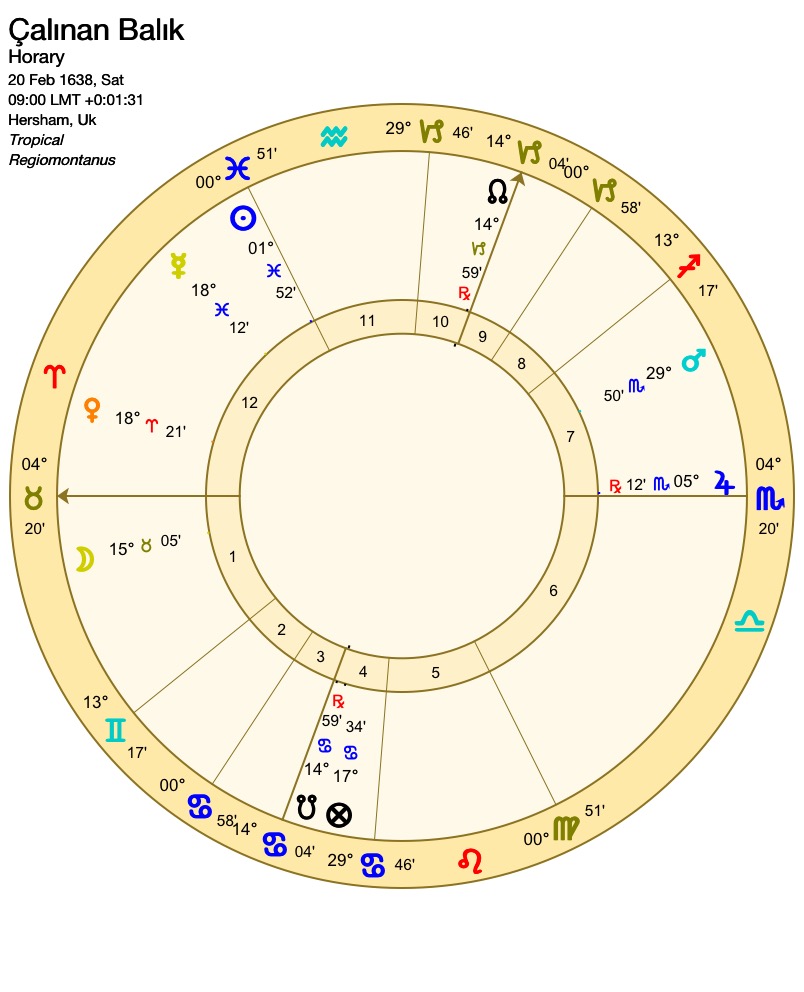
Step 1: Radicality Check
At the start of every horary, Lilly checks whether the chart is "radical" -- that is, fit for judgment. Radicality conditions include:
Agreement between the hour lord and the Ascendant ruler: The planetary ruler of the hour the question was asked and the ruler of the Ascendant sign should be in the same triplicity, same nature, or be the same planet. Lilly confirmed this chart as radical.
Early or late Ascendant degree: The first 3 degrees or last 3 degrees of the Ascendant are generally treated with caution. In this chart, the Ascendant is in middle degrees. No issue.
Moon void of course (VOC): Whether the Moon makes any aspects in its current sign is checked. In this chart, the Moon is making active aspects and is not void of course.
You can check radicality and whether the Moon is void of course for your own question in the horary techniques tool.
Step 2: Identifying the Significators
Lilly's (Querent's) Significators
- 1st house ruler: The planetary ruler of the Ascendant sign represents Lilly
- Moon: In every horary, the Moon serves as the querent's co-significator
Indicators of the Stolen Property
- 2nd house ruler (Mercury): The representative of Lilly's property -- in this specific question, his fish
- Part of Fortune: An additional indicator of the querent's "treasure"
The Thief's Significators
- 7th house ruler: Represents the thief
- Sign and degree at the 7th house cusp: Physical description of the thief
Step 3: The Water Sign Pattern -- The Thief's Profile
Lilly's most important observation in this case was the concentration of water signs in the chart:
| Indicator | Sign | Element |
|---|---|---|
| Mercury (2nd house ruler = property) | Pisces | Water |
| Part of Fortune | Cancer | Water |
| Jupiter (in angular house) | Scorpio | Water |
Three different indicators in three different water signs. From this pattern, Lilly drew the following conclusions:
The thief is someone connected to water: Most likely a fisherman or boatman who works on the river.
The fish is stored in a damp place: Water signs physically indicate a damp, basement-level, or water-adjacent location.
Jupiter's role: Jupiter is in an angular position and in Scorpio. Jupiter normally represents noble or wealthy people, but Lilly chose the contextually correct interpretation. The likelihood of someone stealing fish from a warehouse being "noble" was low. Instead, he focused on Jupiter's position in a water sign to confirm that the thief had a water-related occupation.
Critical Principle
Astrological indicators are never interpreted independently of context. The same Jupiter in an angular position might mean "noble person" in a question about royalty, but is read as "a worker connected to water" in a fish theft question.
Step 4: Direction Finding
The concentration of water signs in the chart indicated that the thief and the fish should be sought in the northern direction, toward the river. Lilly narrowed his search toward the fishermen's cottages along the riverbank at Hersham.
Step 5: Perfection Analysis -- Will the Fish Be Returned?
Perfection is assessed by looking at whether an aspect forms between the significators:
Is there an aspect between the 2nd house ruler (property) and the 1st house ruler (querent)? If there is an applying aspect, the property may be recovered. The type of aspect determines the ease of the process: trine/sextile = easy recovery, square = with difficulty, opposition = only if mutual reception exists.
The Moon's role: The Moon moves from its last separating aspect toward its next applying aspect. This movement shows the direction of events. Lilly read from the Moon's movement that the property could be partially recovered.
Step 6: Judgment and Outcome
Lilly's final judgment:
- The thief is a fisherman living by the river who has a water-related occupation.
- The fish is stored in a damp place, most likely a house or shed by the river.
- Direction: North (toward the river).
- Some of the fish can be recovered.
Lilly matched these astrological descriptions with people in his immediate vicinity. The profile fit a specific fisherman living by the river. He obtained a search warrant from local authorities. This also demonstrates how respected Lilly was as an astrologer. The search resulted in some of the fish being found, and the thief confessed.
This Case's Place in Horary History
Lilly's "Where Is My Fish?" case is one of horary history's most important examples for several reasons:
First: It is one of the rare cases where an astrological judgment was physically verified. The thief was actually found and the property recovered.
Second: It demonstrates horary's capacity for "symbol reading." Water signs genuinely pointed to a water-connected person and place.
Third: It is a case that emphasizes the importance of contextual interpretation. The same astrological indicator carries different meanings in different contexts.
Fourth: It shows Lilly's societal position. In 17th-century England, an astrologer held a position respected enough to obtain search warrants from local authorities.
References
William Lilly, Christian Astrology, Vol. II (1647)
This content was prepared for educational purposes. -- Sira Nur Uysal, sirauysal.com