
In traditional horary practice, the answer to yes-or-no questions is found through a dignity-based reception between two significators together with an unimpeded aspect reaching completion. How strong the planets are, which sign they sit in, or how "benefic" the chart looks overall does not change this final verdict. If you are new to the fundamentals of the technique, the horary techniques resource lays out the framework of these concepts first.
In this article I share, in full technical detail, a question my client put to me, the answer I gave through the chart, and the confirmation that arrived seven months later. As you examine this case, I especially recommend paying attention to two things: not conflating essential dignity with the verdict, and choosing the timing unit with the right context.
I. The Question and the Moment
My client asked whether her current relationship would end in marriage. There was genuine uncertainty; the relationship was ongoing, but the formal step everyone expected had not yet been taken.
Horary Chart Details
| Question | "Will we get married?" |
| Date | February 3, 2024 |
| Time | 11:54 |
| Location | Istanbul |
| House System | Regiomontanus |
| Ascendant | Taurus 11°47' |
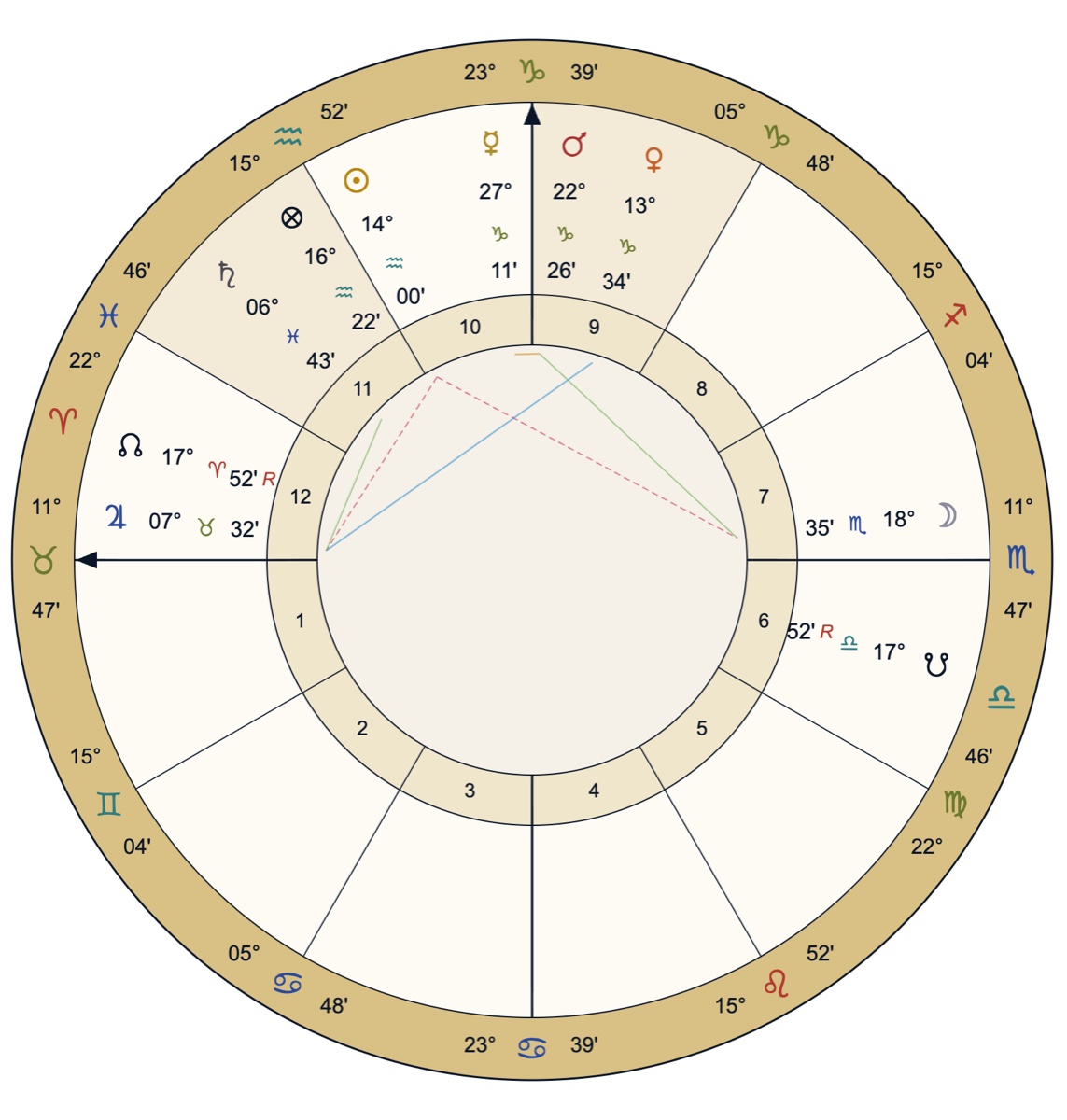
II. Assigning the Significators
The querent is my client; she is therefore represented by the 1st house and its ruler. Since the Ascendant is Taurus 11°47', my client's significator is Venus. Venus also being the natural significator of marriage and relationships makes this assignment even more fitting; the querent and the nature of the question asked meet in the same planet.
The person she wishes to marry (the prospective spouse) is represented by the 7th house. The cusp of the 7th house is Scorpio 11°47'; its ruler is Mars. The other party's principal significator is thus determined to be Mars.
Our co-significator, as always, is the Moon. The Moon, at Scorpio 18°35', is placed directly within the 7th house. This placement shows that the full weight of the matter lies on the relationship side; my client's mind and emotional focus are entirely occupied with the concerns of this house.
Key Positions in the Chart
| Planet | Position | House | Condition / Dignity |
|---|---|---|---|
| Sun | Aquarius 14°00' | 10 | In detriment |
| Moon | Scorpio 18°35' | 7 | In fall |
| Mercury | Capricorn 27°11' | 10 | - |
| Venus | Capricorn 13°34' | 9 | Peregrine (in foreign territory) |
| Mars | Capricorn 22°26' | 9 | In exaltation |
| Jupiter | Taurus 7°32' | 12 | - |
| Saturn | Pisces 6°43' | 11 | - |
III. Both Significators in Capricorn: Sharing the Same Ground
One of the first and most decisive things that stands out in the chart is that both significators are placed in the same sign: Venus at Capricorn 13°34', Mars at Capricorn 22°26'. Both are in the 9th house.
This is an extremely strong testimony in a marriage question. Two significators being in the same sign shows that the parties share common ground, speak the same language, and face the same direction. Capricorn is a cardinal, earth sign. It demands seriousness, permanence, formality, and commitment. The sign itself directly describes the nature of the thing asked about (marriage).
At the level of temperament, Capricorn is cold and dry, and it is Saturn's own sign. This is not a hasty, passing infatuation sprouting on warm, moist ground; rather it is a slow-moving bond that wants a solid form and a formal commitment. And indeed, my client's relationship was exactly this: there was real commitment present, but it lacked the concrete progress that would turn it into formality.
IV. What Dignity Does and Does Not Tell Us
Mars is in exaltation in Capricorn. This shows that the other party's significator is very strong; it stands on its own ground, in a position of standing, influence, and dominance.
Venus, meanwhile, sits peregrine (in foreign territory) in Capricorn. It is neither in its own domicile nor in exaltation. My client's significator does not carry as much dignity as the other party's.
This is exactly where students most often fall into a trap when reading a chart. Seeing that one significator is in exaltation and the other peregrine, they conclude the relationship is "unbalanced" and that the answer must therefore be negative. This is conflating essential dignity with the verdict.
Essential dignity describes how capable, well-motivated, and internally sound a planet is; it does not say whether the event will happen. Dignity gives the strength; aspect gives the outcome. A reader who cannot make this distinction begins saying yes wherever they see a strong planet and no wherever they see a weak one, and it is exactly at that point that horary practice collapses.
V. Jupiter on the Ascendant
In the chart, Jupiter sits at Taurus 7°32', and the Ascendant is Taurus 11°47'. There is an arc of only 4°15' between them. Although by degree Jupiter appears to trail behind the Ascendant line, that is, to still be in the final degrees of the 12th house, the famous classical "five-degree rule" states that a planet this close to an angle (the Ascendant) and in the same sign is counted directly in the 1st house. Jupiter, therefore, belongs to the querent's house in this chart, and moreover sits right on the Ascendant.
The meaning of this in horary is entirely clear: the greater benefic occupies the house that represents my client herself. In the classical tradition, a benefic conjunct the Ascendant signifies protection, good fortune, the untangling of knots, and a favorable outcome for the matter the querent is asking about. Whatever the question, the matter will resolve in a way that serves the querent, that eases her heart.
The layer of reception further reinforces this benefic effect. Jupiter is in Taurus, and Taurus's ruler is Venus; that is, Jupiter is a guest in the house of my client's own significator. Venus hosts it on her own ground. A mutual bond of goodwill is thus formed between the two planets; the greater benefic sits in the querent's house and offers her support.
The meaning we draw from this does not change the "yes" answer given by the conjunction we will see shortly; rather, it completes it. While the conjunction aspect says the marriage will take place, Jupiter on the Ascendant whispers that this marriage will be entirely to my client's benefit, that the outcome will turn out well for her. In horary practice, "What is the answer?" and "What is the quality of the answer (fortunate or unfortunate)?" are separate questions, and the second is most often answered by where the benefics fall in the chart.
Finally, let us note one technical point: Jupiter is peregrine in Taurus, meaning it has no essential dignity of its own. Still, its angular position on the 1st house (the Ascendant) grants it an extremely strong accidental dignity. This is another fine example of the same distinction underlined earlier in this article: a planet's own essential capability and strength is one thing; the capacity for action and influence granted to it by its position in the chart is another.
VI. The Verdict: An Applying Conjunction
Now to the matter itself: is the bond forming?
Venus at 13°34', Mars at 22°26'. The distance between them is 8°52', and Venus trails behind Mars.
Looking at daily speeds, Venus moves 1°14' per day while Mars moves 0°46' per day. Venus is much faster and is rapidly closing the distance. The two significators are in a clear applying conjunction.
The horary answer to this configuration is a definite "YES": the marriage will take place.
There is no impediment to prevent the conjunction. Both planets are direct, both reach each other without changing sign, and there is no other planet intervening to cut the light (prohibition). There is no refranation. The bond will certainly form.
VII. Timing: How Is the Unit Chosen?
8°52' remains to the conjunction. The classical counting method takes the arc between the two and converts the unit into a measure of time according to the nature of the sign. Capricorn is a cardinal sign, and cardinal signs accelerate the count.
If the scheme is applied in raw form, with no filter, 8°52' could be read as "nine days" -- that is, roughly nine days from the moment of the question (late February).
This is exactly where the astrologer must pause and think. An astrologer cannot make claims that sound miraculous, out of context. A marriage cannot be organized in nine days; the process requires an engagement, families meeting, preparations, and formal procedures. The nature of the thing asked about determines which time unit is to be used. The resolution of a toothache can be measured in days, while a marriage process is measured in months.
Taking the time unit as "months," 8°52' gives us a window of roughly nine months. On this basis I told my client that the marriage would take place, and that it would be concluded within the coming year.
Choosing the unit is the step of horary art that demands the most context and experience. The chart gives you a mathematical number; the reality of the question itself tells you whether that number will be days, weeks, or months. An astrologer who skips this step gives a wrong verdict even if the math is done correctly.
VIII. The Moon and the Tone of the Outcome
The Moon, at Scorpio 18°35', is in the 7th house and in fall. It must be remembered that this condition of the Moon does not change the final verdict; it only describes the psychological tone of the process. A Moon in fall in Scorpio very clearly tells us that the waiting was far from comfortable, that my client felt great unease and heaviness from this uncertainty. Indeed, this is exactly the motivation that led to the question being asked.
That said, the first aspect the Moon will make is a sextile (a harmonious aspect) to Mars, only 3°51' away. That is, the co-significator carries its light directly to the other party's significator. This is a very positive second testimony supporting the conjunction between the two.
(A technical note: the Sun's antiscia falls at Scorpio 16°00'. This point falls directly within the 7th house and is only 2°35' from the Moon. Since the orb is at the edge, I do not present this as primary evidence, but I include it among my notes. Antiscia forms hidden bonds not visible in the chart, and in a marriage question any testimony falling in the 7th house is worth noting.)
IX. Verification
My client married that same year, in September. The question was asked on February 3, 2024; the wedding took place roughly seven months later.
The chart made two clear claims: the marriage would take place, and it would happen within a year. Both were confirmed.
Here it is worth dwelling on the small gap between the nine-month window given by the count and the seven months it actually took. Classical timing counts do not give you millimetric precision but rather an order of magnitude: is it days, weeks, or months? Within that order, the astrologer offers a reasonable window. If you try to give your client an exact date, "to the day," you place on the astrological tool a burden it was never built to carry.
X. What Did We Learn?
This case offers us two fundamental lessons:
- What looks strong and what is decisive are not the same thing. At first glance, Mars's splendor (its exaltation) and Venus's weakness (being peregrine) stood out in the chart. Looking at this picture, one could have argued there was an imbalance between the parties and that this would not work out. Yet what actually delivered the verdict was that the two significators shared the same sign and that the conjunction between them completed without impediment.
- In timing, mathematics cannot override logic. The arc only gives you a number; the subject of the question determines the unit. A marriage does not happen in nine days. Reading the number as months is not bending astrology's mathematics, but rather respecting the nature of the question.
The first and most vital question to ask in horary practice is: is the bond forming? Everything else is merely detail describing the quality and timing of that bond.
References
- Bonatti, Guido. Liber Astronomiae. Translated by Robert Zoller and Robert Hand. Project Hindsight, Golden Hind Press, 1994.
- Lilly, William. Christian Astrology. London, 1647.
- Ptolemy, Claudius. Tetrabiblos. Translated by F. E. Robbins. Loeb Classical Library, Harvard University Press, 1940.
- Sahl ibn Bishr. The Introduction to the Science of the Judgments of the Stars. Translated by Benjamin Dykes. Cazimi Press, 2008.
This content is a case analysis prepared for the purpose of classical astrology education; no information regarding the client's identity has been shared. · Sira Nur Uysal · sirauysal.com